
Mack Modes in Hypersonic Transition
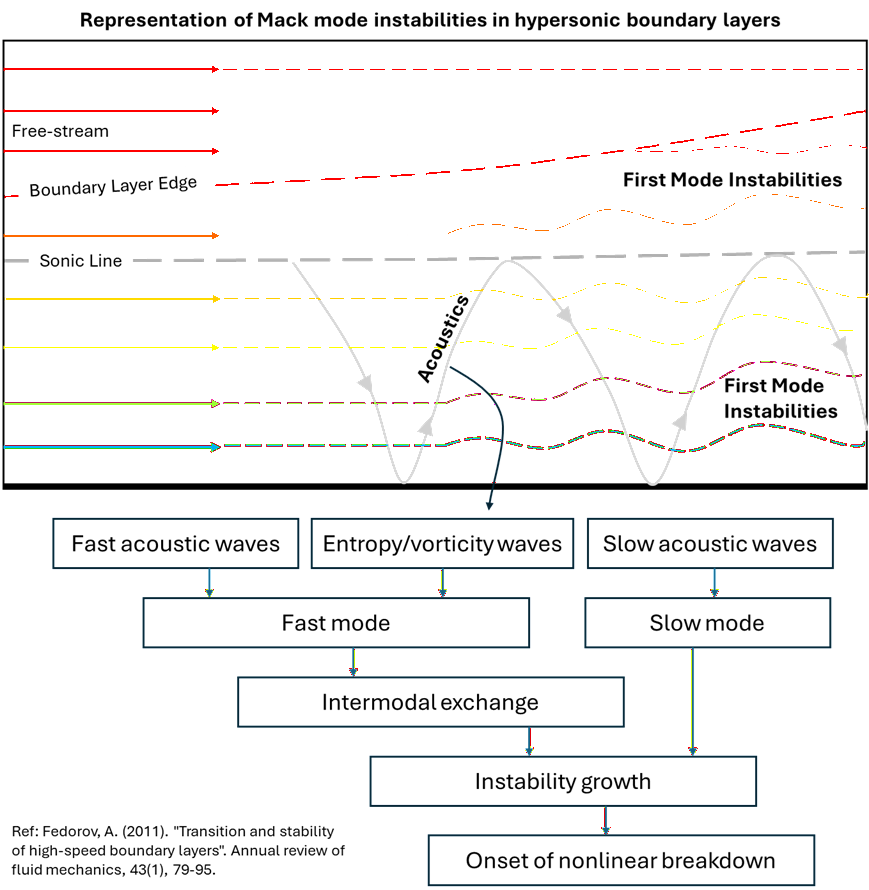
A hypersonic boundary layer does not become turbulent through a single instability pathway. Instead, different disturbance families compete for amplification depending on the local thermodynamic and acoustic environment of the flow. Among these, the most characteristic mechanisms are the first and second Mack modes.
First and Second Mack Modes
The first Mack mode is essentially the compressible extension of the viscous shear-driven instability familiar from lower-speed boundary layers. Disturbances extract energy from the velocity gradient within the boundary layer, leading to the amplification of relatively low-frequency waves. As compressibility increases, the structure of these waves changes, but their physical origin remains tied to shear-layer dynamics.
The second Mack mode arises from a fundamentally different mechanism. As shown in Mack’s analysis, it behaves as an acoustic-mode instability. High-frequency pressure waves become trapped between the wall and the sonic line inside the boundary layer, forming a resonant waveguide. Repeated reflection and reinforcement of these trapped waves can lead to strong amplification when the boundary-layer thickness, wall temperature, and Mach number support this resonance.
Consequence and Mitigation
The practical consequence is a sharp rise in heat flux and skin friction once these instabilities break down and the boundary layer transitions to turbulence. In many slender hypersonic configurations, the second mode dominates the transition process, making it central to thermal protection and vehicle design margins. Mitigation strategies therefore focus on weakening the mechanisms that feed these modes. Geometric choices such as nose bluntness can reduce receptivity to disturbances; wall-temperature control can alter stability characteristics; and ultrasonically absorptive porous surfaces have been shown to damp the trapped acoustic waves associated with the second mode.
References:
Mack, L. M. (1990). "On the inviscid acoustic-mode instability of supersonic shear flows: Part 1: Two-dimensional waves". Theoretical and Computational Fluid Dynamics, 2(2), 97-123.
Fedorov, A. (2011). "Transition and stability of high-speed boundary layers". Annual review of fluid mechanics, 43(1), 79-95.
Kimmel, R. (2003). "Aspects of hypersonic boundary layer transition control". In 41st Aerospace Sciences Meeting and Exhibit (p. 772).
